
A blog about Learning and Technology; New Learning for everyone within the digital comfortzone.
Sunday, 8 April 2012
Cyberbullying in Holland: banga lists
Cyberbullying comes in many forms and shapes and the latest one is called a Banga list. Banga is street for slut. Girls with a certain reputation may find their names on one of those lists, gaining instantaneous and - potentially- eternal Internet notoriety - whether the slander is true or not. These Banga lists are similar to the German 'isharegossip' site, they are a platform for bullies. In Germany isharegossip was hacked, forcing its owners to shut itself down. In the UK and the US cyberbullying has become a punishable offense. In the Netherlands on the other hand cyberbullying seems to be taken with a large pinch of salt. A number of so-called pragmatic Dutch don't see the Banga lists as a cause for concern. Statistics show that 4% of teenagers are being cyberbullied. Even though this number seems low compared to some US studies where up to 68% of teens are reported to have been cyberbullied, 4% still represents 60.000 children. Peter Nikken, professor Media Education, is not impressed: "It's normal that kids bully one another, that's what they do." Media researcher Linda Duits shares his view: "It's not as if you'll never find a job again when your name is on such a list. Besides, bullying is part of youth culture." De Volkskrant presents these two expert views to conclude that the Banga lists are nothing but a media hype. Yet many girls will beg to differ. Finding themselves on a Banga list, their reputation is up for grabs. Does Ms Duits know for a fact that this digital sleeze will be removed from the Internet in a few year's time? What about the effect on the girls themselves? Cyberbullying has to be taken seriously. It is extremely harmful simply because social media multiply and accelerate its effects. One 13-year old's suicide last week coincided with the publication of her name on a Banga list. Still, the Volkskrant certainly won't jump to conclusions and is happy to leave this media hype where it belongs - on the world wide web. Let's hope it will not stay there forever.


Sunday, 13 November 2011
Be careful what you LIKE
Just 'liked' MacDonalds so you could get that cheeseburger voucher? Now all your friends know it as well. Check your Facebook settings regularly, both the privacy and the account settings. There are quite a few settings under 'account' which have everything to do with your privacy - just check the elements on the left hand side of your screen. One of them is Facebook Ads. If you click on this, check your so-called social ads. If you don't want all your friends to know that you like Tchibo, Sony or MacDonalds, then set it to 'no one'. Often companies and organisations ask you to like them so you get some free deal, or unlimited access to their website resources. After you've liked them, your likes will be integrated in ads which can be shown on your friends' walls - unless you change your settings. Here is a screen grab from my own settings:

Saturday, 5 November 2011
MAKE A POWERFUL POINT
Conferences... what use are these archaic events in this digital day and age where we can find all the information we want at the tip of out fingers? This question has been asked by both speakers and conference visitors in the past years, and usually the outcome was mixed. We've heard most of the input all before, we spend too much on entrance fees, overprized accomodation and bad food, get jetlagged and dramatically increase our carbon footprint.Yet, we are human beings in need of personal contact; we like a drink and a bit of lame gossip, so we keep attending conferences. O yes - and if you're lucky you get inspired. You listen to the likes of Michael Wesch and Sugata Mitra and know that learning has forever been transformed by technology - whether learners and teachers realise it or not - embrace it or not. They are the gems, those rare and wonderful speakers that make you increase your carbon footprint year after year. Certainly, more presenters have a good story to tell, but most spam their own message by putting up a slideshow with one million words and zero visual input. We are not only living in exponential times (as Michael Wesch puts it), we are living in visual times, and we require visual input, like it or not.... Creating powerful slides is not rocket science anyway; below is some visual support which may be useful when you find yourself going to the next conference. Go ahead, make your point: http://www.slideshare.net/Shelearner/make-a-point-presentation-annemieke-akkermans
Sunday, 16 October 2011
13-year olds want to learn about Internet Safety
As media coach and teacher I also teach 7th graders at an international school in Berlin. A first questionnaire among ca. one hundred 12- and 13-year olds places Internet Safety as their number one concern, whereas this has not been part of the official curriculum so far.
The results of the September 2011 questionnaire:
• 99% have one or more computers at home
• 95% have Internet access, 5% doesn’t know.
• 40% use the pc daily, 25% use the pc only in weekends, 35% use the pc ‘sometimes’
• Ca. 10% of parents do not use computers. These children all have their own computers.
Asked what the 7th graders wanted to learn most of all, this is the top 3:
o Internet Safety (cookies, spam, viruses, digital identity)
o Typing skills (mostly for speed)
o Video editing
The 7th graders picked up basic digital skills from:
o A parent (36%)
o Older sibling (16%)
o Self (12%)
o Other family member (8%)
o School/ IT-course: 4%
o Without skills: 24%
First conclusions: More than half of all 7th graders have learned their basic digital skills from parents and siblings. The few students who mention school as the place where they learned digital skills, attended international schools abroad, such as Singapore and Australia. Only 4% mention 'school' as the place where they learned their digital skills. Internet Safety has so far not been included in the school curriculum, yet this is what most of the 7th graders mention as their nr. 1 priority. They wish to learn about cookies and spam, how to protect themselves against viruses, how to create and protect their digital identity and how to handle cybermobbing
The results of the September 2011 questionnaire:
• 99% have one or more computers at home
• 95% have Internet access, 5% doesn’t know.
• 40% use the pc daily, 25% use the pc only in weekends, 35% use the pc ‘sometimes’
• Ca. 10% of parents do not use computers. These children all have their own computers.
Asked what the 7th graders wanted to learn most of all, this is the top 3:
o Internet Safety (cookies, spam, viruses, digital identity)
o Typing skills (mostly for speed)
o Video editing
The 7th graders picked up basic digital skills from:
o A parent (36%)
o Older sibling (16%)
o Self (12%)
o Other family member (8%)
o School/ IT-course: 4%
o Without skills: 24%
First conclusions: More than half of all 7th graders have learned their basic digital skills from parents and siblings. The few students who mention school as the place where they learned digital skills, attended international schools abroad, such as Singapore and Australia. Only 4% mention 'school' as the place where they learned their digital skills. Internet Safety has so far not been included in the school curriculum, yet this is what most of the 7th graders mention as their nr. 1 priority. They wish to learn about cookies and spam, how to protect themselves against viruses, how to create and protect their digital identity and how to handle cybermobbing
Monday, 30 May 2011
Mobiles in School
"Children should not have mobile phones, it is unnecessary and ridiculous." One teacher's opinion. Another one agrees that mobile phones can be taken to school, but should only be used outside of school hours. A third teacher uses his smartphone to send homework to his students, and expects the students to collaborate online, and the finished assignments to be sent to his Facebook account.
Most educational institutions do not know how to deal with mobile phones. Many schools adhere to the switch-off-during-school hours-policy, but is this is a sustainable strategy in the ever-increasing mobile future? Dutch research shows that the use of mobiles and smart phones reduces students’ concentration and endangers school safety. Mobile phones, often kitted out with a camera, are sometimes used for harassing pupils and teachers. Nasty videos appear on the web, and people are badmouthed on websites and social networks. Schools are often not aware of the negative, nor of the positive effects of mobile use. This is why each school requires strict and clear rules on the use of mobile phones, and media use in general. The report also urges teachers to look at their own online behaviour, such as on Facebook and Twitter. More can be found on the Dutch website of the Nationale Academie voor Media en Maatschappij.
Most educational institutions do not know how to deal with mobile phones. Many schools adhere to the switch-off-during-school hours-policy, but is this is a sustainable strategy in the ever-increasing mobile future? Dutch research shows that the use of mobiles and smart phones reduces students’ concentration and endangers school safety. Mobile phones, often kitted out with a camera, are sometimes used for harassing pupils and teachers. Nasty videos appear on the web, and people are badmouthed on websites and social networks. Schools are often not aware of the negative, nor of the positive effects of mobile use. This is why each school requires strict and clear rules on the use of mobile phones, and media use in general. The report also urges teachers to look at their own online behaviour, such as on Facebook and Twitter. More can be found on the Dutch website of the Nationale Academie voor Media en Maatschappij.
Friday, 27 May 2011
What's Your Story? Grand Prize Winner
Cool little video. international video contest that empowers youth to be leaders in educating others about being safe online. As long as half of all parents and teachers are themselves uncomfortable online, who should teach their kids and students about online safety? Gen X and Gen Y should be learning together.
Monday, 18 April 2011
BANKSY
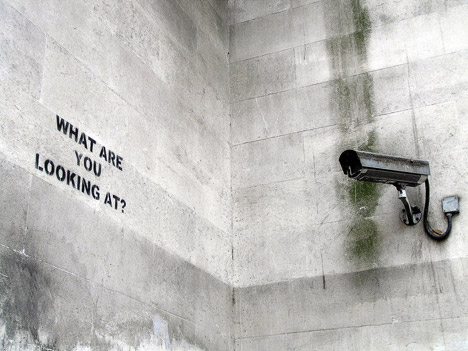
My son loves him; Banksy, formerly known as street artist. His art (formerly known as vandalism) sells at Sotheby's for several hundred thousand pounds a piece, and can be seen at renowned art galleries the world over.

I have admired Banksy's work ever since 2008. Years earlier I worked for the Weather Channel and was based in Newman Street, W1, London. Across the street from out building was an old post office, and a huge blind ugly wall, kitted out with the standard CCTV cameras which are omnipresent in London, and at the time cause for a lot of debate as to whether CCTV - big Brother watching - was a good or a bad thing. Reality soaps have long since taken the sting out of CCTV cameras in the street.... Anyway - one day in 2008 this ugly wall was decorated with a piece of graffiti - or rather 'street art'. The latest stunt by Banksy, pulled right under the eyes of the cameras.... I loved it, and so did the press. |
Yesterday we watched a documentary about Banksy, 'Exit Through the Gift Shop'- which in the end turned out to be more about the guy who had managed to capture the elusive Banksy on film, Thierry Guetta. More of a clever businessman than an artist, Thierry later tries his hand at street art himself, using the techniques (and themes) he picked up from Banky and other street artists he has followed for years, mixing it with clever marketing (using social and regular media) and becoming an overnight commercial success.

Banksy's comment: "He broke all the rules - although we're not supposed to have any rules...". In the end, the film has been finished by Banksy himself, when he realised Guetta was only capable of recording, not of cutting a movie. A very interesting documentary, although the B-film - a short video purely about Banksy, contains the real gems for Banksy fans. Pictures, interviews and great quotes such as from the critic who initially felt Banksy's work was just "an entertaining bit of rubbish", or how the purpose of art is "to get up the noses of the establishment". One artist who was very critical about Banksy's use of stencils ("real street artists were ready to beat him up for using such gay techniques"), concluded that every single street artist was a real artist, and that Banksy "just got a fucking headstart on us". Well, yes - isn't that the difference between the real stars and the legion of following nobodies: a head start? Below are some more great Banksy originals...



Saturday, 16 April 2011
Cool Tool
Another cool tool; WeTransfer. An increasing amount of providers offers the use of their server space to store and transfer large files. I just received a large photo file via WeTransfer. One click, and hundreds of pictures or manuscripts are transferred via the cloud. WeTransfer is a free platform in transferring large digital files up to 2Gb per transfer, such as presentations, photos, videos, music, documents and more. Free, of course. Added bonus: no registration required. They are no samaritans, WeTransfer makes money by selling advertising space, and they also have a commercial service (WeTransferChannel). In the meantime we reap the benefits of another cool free online tool.
The Google Dictator
As other strong brands, Google likes to play around with its logo. It started with inconspicuous adjustments, mostly on the two OO's. You can tell that marketing research showed that the Google clientele (i.e. just about everybody) must have appreciated this, because the Google art department has gone berserk. Great was 'the 50th anniverary of Yuri Gagarin's first trip into space' last week. It even inspired a fun art lesson that day. Looking at the Google Logo overview , the Gagarin Google logo seems to have disappeared - too many US complaints? The 200th anniversary of Robert Bunsen (Europeans go; who?! The guy who invented the Bunsen burner, which is used in labs) inspired another beautiful Google logo, very subtle... see?

Today I open Google with mixed feelings. It is the 122th anniversary of Charlie Chaplin's birth (122??), but as today's Google logo celebrates the brilliant film maker with a reference to 'The Great Dictator', with the actual logo showing nothing but gothic nazi font and a play on the hitler moustache - today's logo reminds me more of Hitler than of the brilliant Chaplin. Or is it just me...?!


Today I open Google with mixed feelings. It is the 122th anniversary of Charlie Chaplin's birth (122??), but as today's Google logo celebrates the brilliant film maker with a reference to 'The Great Dictator', with the actual logo showing nothing but gothic nazi font and a play on the hitler moustache - today's logo reminds me more of Hitler than of the brilliant Chaplin. Or is it just me...?!

Wednesday, 13 April 2011
TGIF on Facebook
What do you do on a Friday evening? Visit your friends? Yes - according to research by Buddy Media Friday evening is the time when most people visit their friends, and do a bit of shopping - on Facebook that is. Commercial Facebook use is up by 18% on Friday evening. During normal work hours commercial messages via Twitter and Facebook receive less attention. I wonder why this is news actually - it seems a no-brainer. Especially when your supervisor is one of your virtual 'friends', you should be careful not to use social media during work hours. Big Brother may be watching you, and use it against you. And she would be right to do so as well, at least according to a study by IT research company Nucleus Research, which shows that companies that allow users to access Facebook in the workplace lose an average of 1.5% in total employee productivity. The survey of 237 employees also showed that 77% of workers who have a Facebook account use it during work hours. Interestingly enough some studies show the opposite to be true. A University of Melbourne study shows that as many as 9% workers who indulge in such (Facebook or Twitter) activity have better productivity than those who don’t. The study involved 300 workers and 70% of those engaged in workplace Internet leisure browsing. It’s author, Brent Coker stated: Short and unobtrusive breaks, such as a quick surf of the Internet, enables the mind to rest itself, leading to a higher total net concentration for a days’ work, and as a result, increased productivity. So a bit of couch potato surfing on Facebook is the new smoke break, which is great news for the non-smokers among us.
Subscribe to:
Posts (Atom)
21st Century Learning

- SheLearner
- Teacher, trainer, Head of IT, mum of three online teens, into social networks, open educational resources and visual learning. Head in the Global Cloud and feet in the Dutch clay.