

A blog about Learning and Technology; New Learning for everyone within the digital comfortzone.
Tuesday, 6 December 2016
Makey Makey
Makey Makey is magic. It's a simple micro controller that allows you to make any kind of conductive object or material interactive, as long as it is connected to your PC. A Makey Makey kit costs around 55,- and comes standard with alligator clips to connect your Makey Makey set with objects such as bananas, play dough, anything that is conductive. After I introduced it in our Coding/Maker workshop, the students all wanted to get their hands on it, so today I ran into the biggest Conrad shop and of Berlin-Schöneberg and asked whether they sold Makey Makey kits in the store - as I saw they sell them online. "Wie bitte?!" The lady behind the information booth looked as if I asked her something entirely inappropriate. "Was ist das?" she demanded. I was in a hurry and not sure whether I could explain what this micro controller does, so I asked her whether she could just check her computer - the answer was no. I should ask inside. After two salespeople re-directed me to someone else, I talked to what should have been the top expert. A tall guy, missing a front tooth and proudly wearing a button that said 'tekkie', looked at me with a confused look on his face - my question irritated him. He was sure that I mentioned the wrong name. In the end he googled it and told me he could order it online. No thanks, I can actually do that myself... So Makey Makey is not yet known to the Conrad Tekkies, but my students love it and have started creating interactive room-mazes, Scratch games controlled by bananas and interactive posters for my younger students. I just got a roll of copper wire for further projects, and to be honest, I can't wait! Check the video here.


Tuesday, 27 October 2015
Blessing and Curse of the Internet
I had just texted a fellow student "Found a great tutorial on binary arithmetic, why can't our university lectures be simple and effective like this?!"
Being a part-time Computer Science student, we are suffering from a severe case of uninspired 'frontal unterricht' at our German university. Therefore I am often on the look-out for more informative and interactive bits and bytes, such as video tutorials. I had stumbled upon a good lecturer called Carl Herald, who managed to explain why 1 plus 1 = 0 in less than one minute, and then continued to explain the remaining binary algebraic puzzle in a clear and friendly voice on his YouTube Channel. Many people thanked him in the comments. "gr8 vid i love it!" "Thanks! Wasn't taught the "borrow" method in class." "Thank you, well explained!" For me it was renewed evidence of how technology can support learning.
Then the latest comment caught my eye; "All of you guys know that this guy raped his 9 year old son? check it out for urselfs". Below it he had posted a link to these reddit articles. I wanted to know what was going on and scanned some of the other comments, which were mixed. It seemed many people were in disbelief, others agreed that it was the same guy. Only a few clicks produced articles such as these, which confirmed that this friendly sounding programmer, who had over 200.000 views on his You Tube channel, was indeed the sick person who had abused his child and shared the video evidence of this horrific crime with an online pedophile porn network. He faced many charges and went to prison. I only had to check the latest article to find out that he had taken his life, not too long ago.
The Internet made it possible for him to share his videos, both the programming tutorials and the child porn; the blessing and curse of the Internet in one sad sick story.
Would you visit his tutorials?
Create your own user feedback survey
Monday, 5 October 2015
An interactive Storify on the effect of (video) Games & your Brains
My presentation slides plus a selection of research and findings on the effects of videogames on learning and playing. We know about the huge motivational impact of video games. How do we leverage that power?
https://storify.com/Shelearner/games-and-your-brainsSunday, 4 October 2015
Teachers, don't be afraid - Learn From the Learners
Berlin, Germany. The place where I have been living and teaching for more than a decade now. Technology plays a big role in German industry. Remember Audi? 'Vorsprung durch Technik' Even when you don't speak German, you will surely understand the gist. Alas, it doesn't seem to extend to technology in education. When it comes to classrooms, technology is supposed to take a hike. If I may generalise a bit; I'd say Germans are careful, they think before they do, they stick to rules and regulations. Not a bad thing, but it may get in the way of innovation - especially in education. For years I have been trying to get media skills (or Digital Skills) integrated in our international state school's curriculum. Training teachers, offering workshops, rasing funds through the parent association in order to set up PC labs, classroom PCs, WiFi and soon - hopefully - our first tablet class. Last night we had a parent evening. Parents were asking why on earth the students were allowed to bring mobile phones to school... Nobody seemed to think this was an odd question. many teachers take pride in banning mobile phones from their classrooms. Research? "They should use the (one) classroom PC..." Whereas we all see how our kids use cyberspace or however you want to call the digital world - it is an integrated part of their lives. Facebook is used to share homework assignments, to collaborate - yet parents only seem to see the informal chats, not the learning aspects. But just look at the research possibilities, the tinkering, coding, creation... how can that not be a part of a mature, contemporary curriculum? We have started offering workshops on gaming, minecraft, coding etc. by students. Teachers enjoy it - they are asking whether the students can come in and teach them how to blog, how to set up their phones and so forth. They are losing the fear to learn from the fastest learners - their students. As head of IT at our school, I received a student request last week by two girls who are using the 'wifi for students' issue as their most important school speaker election campaign topic. Their poster is pretty cool - using the 'Back to the Future' film poster design. I feel something is finally happening - the kids are speaking out (using digital technology to make a point :-) and hopefully closing the digital divide. Lesson here? Let's learn from the kids - they were born with technology and can really show us the way. At the same time they have the right to learn from our experiences. We know how vulnerable our privacy has become - it is an important lesson to share- yet not one that should keep progress away.


Sunday, 22 March 2015
Copyright poster
Can I use that picture?
Often it isn't clear whether an image can be used - what if it is only used in the classroom? Use Creative Commons to make sure that images may be used, and always mention the source of your images. Use this poster to find the way to proper copyright usage. It comes from http://thevisualcommunicationguy.com.
x
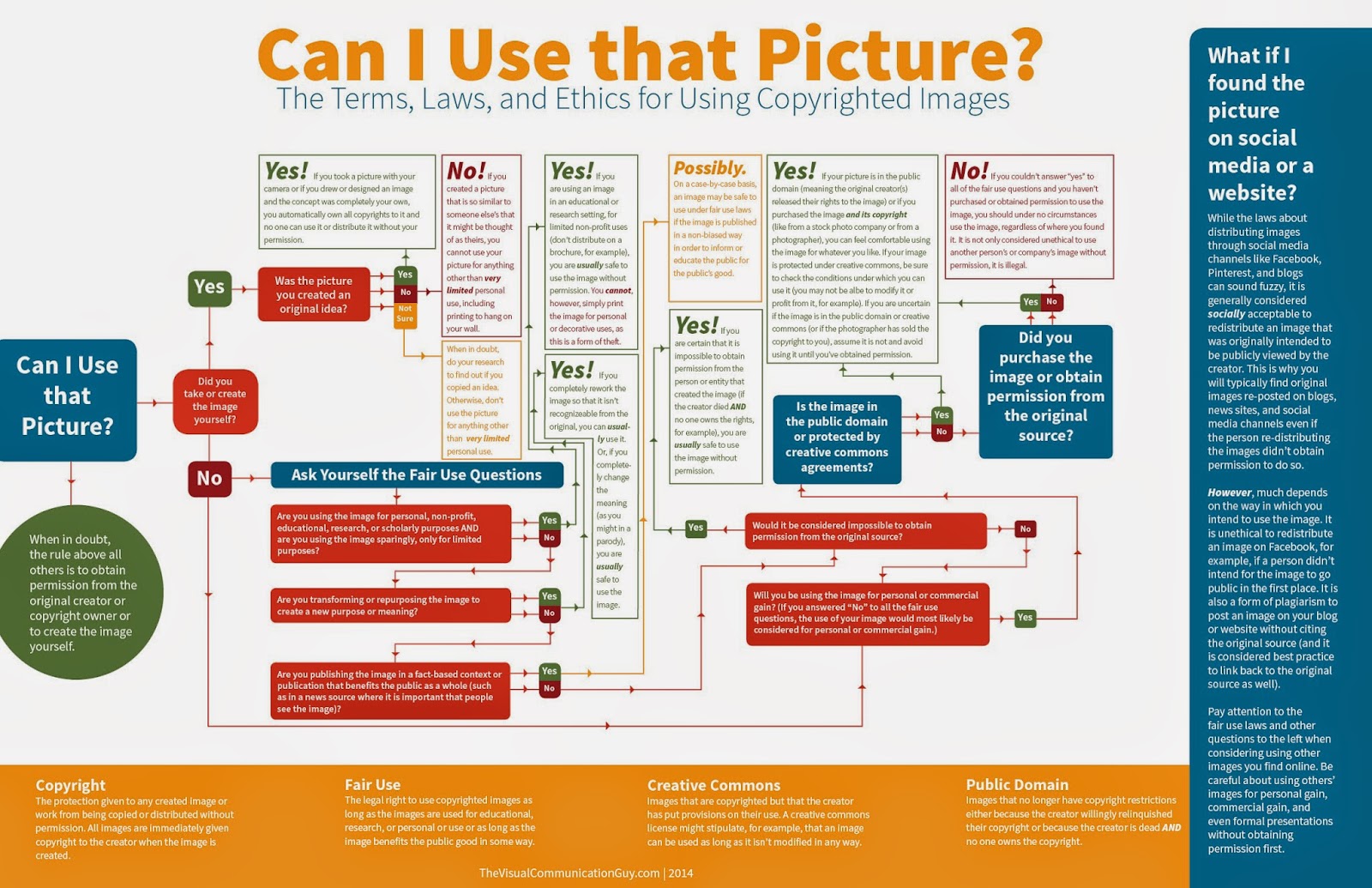
Often it isn't clear whether an image can be used - what if it is only used in the classroom? Use Creative Commons to make sure that images may be used, and always mention the source of your images. Use this poster to find the way to proper copyright usage. It comes from http://thevisualcommunicationguy.com.
x
Image by Curtis Newbold - http://thevisualcommunicationguy.com
Online Communication between Students and Teachers
Although there are still colleagues who refuse to converse with
parents via email, most teachers have embraced (or at least come to terms with)
digital forms of communication. Unfortunately their students have grown up with
Facebook Groups and WhatsApp and only use email to create social media and
gaming accounts. Emails by teachers are often not read in time for the test or
class trip info - or not read at all. Teacher-student communication via social
media such as Facebook involves potential ethical and social pitfalls and is
not advisable, in some countries even unlawful. A Learning Management System
such as Edmodo, Lernraum Berlin or Scolibri could solve this, but as our school
is still in the trial phase, needs more time. So how can teachers and students
communicate online? A free app called Remind provides a solution by offering a
safe way for teachers to text message students and stay in touch with parents.
Apparently one in five teachers in the US uses this app. It is easy enough: Go
to www.remind.com/#sign-up-modal and/or
download the free app for iOS or Android. In ‘classes’ add your class,
for instance 8ASOCS or 10BEnglish. The app will provide a code for you to share
with your class. After the students (or parents) have downloaded the Remind
app, all they have to do is find and join the specific class, using the code
they received from their teacher. From now on, whenever the teacher has to send
out a message (a test or homework reminder, to notify students of a meeting
place, or an absence), everyone who has signed into that class will receive an
update – a reminder if you like :-)
Saturday, 10 January 2015
Digisponsibility
Raising responsible citizens, or so-called digizens, is not done by blocking apps or installing massive firewalls that filter out the useful and the useless stuff. When our children start riding their bikes, we can't simply take away the speeding cars or forbid them to cross the main road. It is not about collecting mobile phones and tablets at the school door in the morning. We also don't collect their sweets in the morning. It is not about restricting the world of our sons and daughters and students, but rather about opening the world and explaining it to them. We need to teach them to be responsible online, to be digisponsible. It is about their digisponsibility online. Knowing about the wealth and pitfalls of the world wide web, learning how to stand up for yourself and others, online. How to behave, how to say no, how to play and learn and work online. We need to teach it at school, we need to show our children how to do it, how to be digisponsible.
Sunday, 9 November 2014
MY ONLINE LEARNING CHALLENGE - PART 1
I confess; I spend too much time online. Or rather, I spend too much time procrastinating online. Not always of course: writing emails, ordering materials for school, researching lesson plans; my inner police officer accepts all that. Then the officer takes a hike and I find myself engrossed in the latest episode of Mad Men or the Mentalist. These series are more addictive than cheese and onion crisps. Last night I watched the final episode of the Mentalist. Yes! I finally know who Red John is, I know what happened to Lisbon and Patrick, I need not to watch any longer - I am released...
So now what? At school I am continuously promoting digital technology; how wonderful it is! The things you can learn! The open educational resources! So why do I turn into a series-zombie at home?! My inner police officer won't allow it any longer. I need a challenge. I want to use the online technology to my disposal, in order to learn a new skill. But what? From the corner of the guest room, my sadly forgotten and dusty guitar is calling my name. She's done that before, but her rusty call was never loud enough. Until today; I am going to learn to Play the Guitar. Today it is November 9th, the first day of my online learning challenge.
TUNING
My 30 year-old guitar first needs tuning. I must have learned this a long long time ago, when I was about 12. I remember I'm supposed to play something like a chord that has to sound the same as another chord, or something like it. My guitar lessons being ancient history, there surely must be an easier way nowadays...? I first tried YouTube, tuning my guitar listening to the correctly tuned strings on one of numerous free YouTube websites, such as http://www.guitarforbeginners.com/Lessons/Tuning_Your_Guitar_By_Ear.html by a friendly sounding guy called Kirk Lorange. You have to have a pretty good ear to tune your guitar this way, but I thought I was doing rather well. After having done exactly as Kirk said, I thought I was ready for the next step. I found another website by Marty Schwartz, called Beginner Guitar Lessons - that sounded just about right. Upon trying the very first chord, the simplest of basic chords called E Minor, I realised that my E Minor sounded very different from Marty's E Minor. I had the right fingers in the right position, but my cat looked at me like I was stringing up his next-door feline mate.

I went back to Marty Schwartz's Beginner Guitar Lessons. The guy sounds amazing and he makes it sound so easy to do what he does... I wanted to follow him straight into 'Let it Be' by the Beatles. Marty says it's only four chords, played in various orders. I can surely do that. Then I realised that this Beginner Lesson was not Beginner enough for me, as Marty didn't even stop to explain what on earth a C chord was. I stopped the video and rewound, trying to make sense of his finger positions. I couldn't see whether that ring finger was pushing down on one of the strings or simply hovering above it. Rewind... and again. Then Marty played another chord and again another one. Whoa! I lost track. Ok, I really needed to rewind and first get to grips with some basic chords - literally.
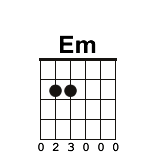
I typed in Basic Guitar Chords for Beginners and that brought me straight to http://www.cyberfret.com/guitar-chords/7-basic-guitar-chords-for-beginners. Just what I needed!
It teaches the first basic chords, and more importantly it showed me how to read guitar chord charts, such as the one on the left for E Minor. the strings coincide with my guitar strings, left to right being top - down. the numbers below correspond with my fingers, the first being the index finger, the second your middle finger, third is ring finger and fourth is your pinky. When it says 0 no finger touches that string. One mystery was solved, when it says X, that string is not played. I got the basics covered! After that I learned my first two chords. E Minor and C Chord.
Now I'll spend next week practicing, because I urgently need to grow some callus on my fingers; they hurt by now! Still, this feeling of actually having learned something new really beats watching the final episode of the Mentalist. Oh well, it's a tie :-)
Monday, 27 October 2014
Help! I am a Connected Educator
Technology for teaching - I love it - but it is not alway the easiest solution for educators (or anyone struggling with online resources for that matter!) For weeks I've been toying with the idea to create a new blog for our class, to keep the parents in my class informed. Informed parents are happy parents who tend to stay out of your hair. Well, generally - you will always have the odd know-it-all-and-aren't-teachers-just-the-laziest-and-stupidest-people-on-earth-parent. But I'm digressing. The idea was to create a password-protected website, so that I could post all the pictures and videos I wanted without worrying over privacy issues. Password-protection turns out to be a premium feature on Weebly, you have to pay to keep those kiddies safe online, so that was step 1. I got my credit card and filled out the details; then it turned out I already had a website under this particular email address. What was it?? I spent 20 minutes trying different usernames and passwords, then asked for a password reset. For this I had a message sent to my phone. As the battery had just gone flat, i had to first charge it. Where was that cable again? After having retrieved the info, I could continue with the sign-up process for the premium service. The classroom blog was a reality shortly after that. Well - in theory. Now all I had to do was build it. As all my classroom and project photos are on my phone, I wanted to send them to my Google email account, so I could access them from the iPad I was working on. It appeared that I could only access one of my google accounts, not my school email account. Why? No idea, one of those online mysteries. I thought Chrome would be a better browser, as I use so many Google products, and so went to get the Chrome app. After signing into the App store, Chrome was downloaded onto my iPad. By now I spent 90 minutes online without having written one single word on the shiny new classroom website yet. I guess I will send another traditional email update to the class community next. But first publish this text on my Blogger account... Who said that connected educators are saving time?
Thursday, 16 October 2014
Teen life online
My thirteen-year old is at home on the Internet. She speaks social media language, simply because she grew up with it. A few months ago Amazon delivered a rather scary looking hair mannequin that she had been wanting for a long time. The life-sized doll's head with real hair (where from? Who? How?) has been groomed and braided numerous times since then. My daughter took pictures of the french braids and dutch plaits and posted them on Instagram, as millions of people do every day. Pictures of cats, nails, beaches and mountains - they need to be shared apparently. Yesterday I realized that she is doing a bit more than just posting: she is hosting. She finds braided hairstyles of her liking, then she removes the background and posts them thus in similar layout on her account, which she calls 'braidinginspiration'. The name is sounds cheerful and tells you what to expect. She posts her own stuff as well as other people's pictures. When I ask her if she gives credits, she retorts "of course! What are you thinking?!" It seems that her generation follow an unspoken code of conduct online. You give credit where credit is due, you use an alias, you reply to comments, you like what's to like and you engage with your audience. When her account hit the 300 followers mark, she created her first contest, using Instagram Academy to easily put 6 photos of different braiding styles together, and asking her followers to choose their favourite. Closing date 3 days later. She got 24 votes and a lot of new followers. She seems to like her followers and feels responsible for them, but she is not obsessed with gaining new followers. I am impressed; she simply shares what she likes and puts a rather professional touch on it. Her thumbs race across the shiny screen - she is congratulating the winner of the contest. The award? Daily mention on Braidinginspiration, for a week. When I asked her just now, she showed me that she now has 443 followers, compared to 400 only three days ago. She is not obsessed with her follower count, but it seems like I am. That is a difference between us, I write and post on Twitter and Blogger mostly for myself but am aware of the online environment. She posts for herself and others, but she sees her platform as her natural habitat: she feels at home.
Monday, 11 August 2014
Powerful Learning starts at the Basis
Being a teacher brings with it the privilege of long summer holidays. That quite some teachers are not idle during that time, becomes clear when you read the great number of posts on the online 'Future Classroom Scenarios' course I am taking currently, by European Schoolnet Academy. I started this course while on holiday in Italy, and trying to connect to the EUN site proved very difficult. Wifi is sporadically available here, and very unreliable. I repeatedly have been kicked out of the site, only to find that my half-written posts have disappeared in some cloudless space. It reminds me of our school situation, and serves as a practical reminder that our utopic classrooms where freely roaming students interact, create and research online, are quite some broadbands away. Until the day that connectivity is as basic a provision as sidewalks, teachers have to improvise in order to be as effective as possible. Start with the basics, such as 'write offline, post online'. In the mean time, we need to focus on the pedagogy and didactics involved with, for instance, BYOD, while the technicians (read; wired teachers) work on practical solutions. I teach a bilingual English/German class at an international primary school and am lucky to have 2 classrooms and a fantastic co-teacher, enabling us to work in smaller groups whenever there is a need. Keywords in our school are collaboration and student-led learning. To organise this better, we are looking to replace our awkward and huge square tables that were devised for 'chalk and talk' teaching, with round tables that could fit 4-6 children. According to the self-organised learning environments (SOLE) theory by professor Sugata Mitra, four kids are ideal for group work. But again, in order to achieve those noble, higher-end goals, we have to start with the basics: where to find round tables that are suitable for the classroom? Recently I saw the perfect set-up at a highway McDonalds, but we decided against that big M in the centre - so if anyone has any ideas?
Sunday, 4 May 2014
Telegram, Threema or Whatsapp?
In medialand things change constantly, so it may not have come as a surprise that the telegram underwent pretty drastic changes. A telegram used to be an oral message laid down in written format, sent via a post office. It was usually shorter than a tweet and faster yet more expensive than a letter. Now Telegram is back, as the rapidly growing alternative for WhatsApp. 'Mail me' turned into 'text me' turned into 'whatsapp me'. The service grew as big as 465 million users and caught Mark Zuckerberg's roving eye. Facebook acquired WhatsApp for 19 billion dollars. As Whatsapp is a free service which only charges one dollar after the first year of usage, it will take Mr Zuckerberg quite some time to redeem that money - even when they double in size, as Business Insider estimated last February. It makes you wonder what the real reason for the acquisition was. After Whatsapp's take-over, many people seemed fed up with the ever-growing Zuckerberg imperium and its NSA-like tendencies, and started looking for alternatives. My German friends massively flocked to Threema, a messaging service from Switzerland. Jawohl! Reliable, non-US based, so worth the €1,59 fee. Its userbase doubled from 200.000 to 400.000 in the first 24 hours after Whatsapp's take-over and kept growing against the backdrop of NSA schandals and ongoing data protection issues. Bye bye Whatsapp, hallöschen Threema. From my 30 friends currently on Threema, 29 are German. The odd one out is a fellow Dutch geek, who probably just wanted to check out the service. On the other hand, many of my international contacts either still use Whatsapp or have moved to Telegram, which seems to be gaining foothold, especially among younger users. It may not play the same safety cards as Threema, but its functionality is very similar to Whatsapp and, most importantly, it is free of charge. My son tried out several options, but still prefers Whatsapp because 'everyone has it' and at his age this is an important factor as group chats are all the rage. So - Telegram does well in the 15-40 age bracket, the responsible and savvy communicators who don't wish to store their data in US-based clouds. Until they realise that Telegram is owned by Pavel Durov, the Russian millionaire responsible for VKontakte, the large social network that is popular in many former Soviet countries. This leaves us with a rather classic question: are Russian clouds safer than American ones? Or not that classic: Durov, who lives in the US, was dismissed as CEO last week, coincidentally after refusing Vladimir Putin's demands to hand over information on opposition leaders. However it may be - perhaps those damn reliable Swiss aren't such a bad alternative after all.
Monday, 3 February 2014
Three Unwritten Laws Of Twitter
Having recently rediscovered Twitter as a tool for Professional Development, I woke up my snoring account to share my thoughts on education and technology. Well, to share great resources if I could help it. I even gained some followers, which made me keen for more (it seems there is a power-hungry dictator hidden in each and every one of us social networkers). Let's just say I like an audience, as it makes my learning experience more authentic (well, this is what we try to convey to our pupils, right?!) Some days Twitter sent me several messages a day that 'so-and-do was now following me!' (the exclamation mark came from Twitter). When new followers looked interesting, I followed them back. Then something interesting happened: I lost followers. Twitter never mentioned those. No exclamation marks here, they simply pushed a button and detached themselves from my world. Lost in space. I felt betrayed. I started paying attention: plus three one day, minus 2 the next. Or worse, the other way around. If the number of your followers still lies within the two digit range, you are actually happy with +2... and sad about -3. Right? So this had become my sad life: chasing my socalled Twitter fanbase. And what an unfaithful and unpredictable fanbase it turned out to be... But why? After a while I figured it out: it is the unwritten Twitter Law of Reciprocity: "I Follow You if You Follow Me - and you've got 24 hours to respond!" Is this why some people have 4.539 followers and follow 4.526 people? What's that, my single reader? Is this me being jealous? Hell no, I am proud of my 91 followers - oh that is 90 now. That must be because of unwritten Twitter Law #2: Don't Talk about Numbers. Pretend numbers don't count, because everyone knows they do anyway. Unwritten Twitter Law #3: Be There All the Time. Even if you have to set a timer to rehash old tweets and blog posts every other month - even if this results in posts like 'Great Tools for Thanksgiving' in March or 'the one that I saw today; 'Summer Vacation is here - What Are You Up To?' It is February.
Good, that makes three Unwritten Rules Of Twitter - I can sense a tweet coming up.
Sunday, 2 February 2014
The Importance of Being in Pre-school
In Berlin, babies go to the Krippe and toddlers go to Kindergarten. Ever since Fröbel and Pestalozzi discovered the importance of playing for the development of young children's motoric and academic skills, the Germans take this part of the pre-school curriculum very seriously. Extremely seriously. Playing in Kindergarten is a must. My children went to a solid Evangelische Kindergarten, where they walked around butt naked in the hot summer months. They built huts in the garden and fed the rabbits. They played football and tag, went on trips to the municipal pool and the adventure playground. They sang songs and slept and did tons of handicraft projects, called 'basteln'. They played until they were blue in the face. Learning the alphabet and counting were not included in the Kindergarten routine; that was for school. When they went to school, the teacher complained about some kids' lack of basic number and letter skills. Those children got homework, so their parents could get them up to speed. My oldest son just did his work experience project at a Kindergarten, which was divided into many different rooms. They had a relaxing room, a craft room, a building room, an eating room, a school room. In his written report my son described those rooms. His comment about the school room was; 'I haven't had the chance to see this room, as it was always closed.' This seems to be the way to do it in Berlin. Let them play until they go to school - until reality hits. Why this gap? Why can't there be a more playful entry into school life? This is what they do in the Netherlands; toddlers go to school when they are four years old - school life still involves lots of playing, but there is an active exposure to letters and numbers. Senator Sandra Scheeres: please re-introduce pre-school - and let educators know that it is ok to mix business with pleasure.
Saturday, 18 January 2014
The Best Education is Marketing
Steve Jobs has said; "The best marketing is education". Turn that around: the best education is marketing. Sell your message, wrap it up nicely and grab your audience's attention. If we want engaged learners, teachers should not be too afraid or lazy to reach out.
The best teachers aim to inspire.
I remember a wonderful math teacher back in my hometown The Hague, called Bart van der Meer. We called him Bart until he turned vice-principal. One day he came to class with a frying pan, a small gas burner and an egg. He cracked the egg and held it high above the pan. The egg came running down in a straight vertical line - as you would expect. His point? To vividly demonstrate how the Y-axis runs, compared to the vertical X-axis - Y having the same sound as 'Ei' meaning egg. I learned that day that teaching is about inspiring, that a good teacher goes the extra mile to grab his students' attention and that visual imagery can be very powerful.
O yes, and I have never forgotten that the Y-axis is the vertical one.
Friday, 20 September 2013
Vorsprung Durch Technik It Is Not
As a technology-friendly teacher in Germany I need newsletters and professional networks like a fish needs water. Some of these newsletters turn out to be a major disappointment and need to be put on the spamlist asap The German newsletter of Pro-Schule (Neue Medien) turned out to be one of those. Mostly identifying the problems and risks of the Internet and technology in general, they sit behind their Commodore 64 and produce headliners such as "Friends with the Teacher? This is What you Should Keep In Mind When You Share Social Networks With Your Students...." or "Does Your Principal Also Expect You Too Fix Your Own Computer?" This week they demonstrated just how avant-la-lettre they really are, when they presented the learning website of the week:
First of all Pro-Schule doesn't even manage to send the direct link to the show, which would have been http://www.wdrmaus.de/sachgeschichten/sachgeschichten/sachgeschichte.php5?id=84. Instead they mention that this video can be found under the I for Internet.... Secondly; this video about Internet stems from 1999, and is nearly 15 years old! As if nothing happened, no cloud, no Wlan, no social networks, no Web 2.0. But Die Maus; that is German culture, history - that is reliable!
|
Derzeit stellen wir Ihnen
interessante und sinnvolle Websites mit Lerneffekt für Ihre Schüler vor.
Heute: Die Maus erklärt das Internet Die berühmte WDR-Sendung „Die Sendung mit der Maus“ bildet nun auch im Internet. Unter dem interessanten und vielfachen Angebot finden Sie auf der Internetseite www.wdrmaus.de die Sachgeschichten der Sendung als Video versammelt, z. B. die Sachgeschichte zum Thema Internet. Klicken Sie dazu auf der Navigationsleiste auf Sachgeschichten den Buchstaben „I“. Das 8-minütige Video erklärt jungen SchülerInnen anschaulich, wie Internet-Adressen funktionieren, was ein Provider ist und wie vernetzte Rechner zusammen arbeiten. Dieses Video eignet sich besonders als Einstieg in den ersten multimedialen Unterricht. |
Vorprung durch Technik - not when it comes to technology for the classroom....
Thursday, 4 April 2013
Nelson Mandela School Wins Award for Use of Technology for Learning
Press Release 4.3.2013

Flex A from the Nelson Mandela School Berlin Wins International Award Sharkie Awards Honor Organizations and Individuals That Inform and ‘Wow’Their Audiences With Outstanding Online Presentations
Berlin —April 4, 2013 — Class Flex A of the internationalNelson Mandela School in Berlin is a winner in the fifth annual Sharkie Awards. The awards program, hosted by Brainshark, Inc., honors organizations and individuals that have created standout video presentations – improving business communications with their audiences across industries. Teacher Annemieke Akkermans was named a winner in the “MyBrainshark”category. Her bilingual class, consisting of 26 first- and second-graders, used mixed media to create an illustrated audio-book, which can be found here.
More than 400 entries were submitted in this year’s Sharkie Awards. Judges from Brainshark and other presentation experts evaluated submissions based on presentation quality, clarity, organization and aesthetics. Entries had to demonstrate effective use of Brainshark’s technology – which lets users transform static documents, such as PowerPoints, into online and mobile video presentations.
“The competition in this year’s Sharkie Awards was especially fierce, with many organizations using online video presentations to communicate with impact,” said Irwin Hipsman, Brainshark’s director of customer community. “Class Flex A of the Nelson Mandela School in Berlin went above and beyond. At a time when it’s increasingly important to break through the deluge of communications, they used this online presentation format to inform, motivate and truly ‘wow’ its audiences. We commend them on the excellent use of Brainshark’s technology.”Digital Skills teacher Annemieke Akkermans: “Our team is always on the lookout for exciting technologies for educational purposes. Appropriate use of digital tools and resources provides a vast array of opportunities for blended learning. Our bilingual class (German/English) really enjoyed bringing this story to life. After listening to it the kids first created then colored their illustrations in vivid crayon, which I photographed afterwards. Post-effects were done with www.befunky.com, another piece of free mobile technology which is great for educational use. Our current 2nd-graders will be able to do all of it without help in a few years’ time. After the Power Point presentation was uploaded, the children recorded their voice-overs on www.brainshark.com. Winning this award has motivated them even more; following a workshop with a professional storyteller they wrote their own stories and now want to turn these into illustrated audiobooks as well… I guess we’ll be busy!”
About the Sharkie Awards
The Sharkie Awards are an annual program, hosted by Brainshark, Inc., the leading sales enablement platform provider. The awards recognize outstanding presentations –honoring organizations and individuals that have demonstrated excellence in their use of Brainshark’s online and mobile presentation technology. More information about the awards program, including a gallery of winning presentations, is now available at www.brainshark.com/campaigns/sharkie-awards-2013.Tuesday, 19 March 2013
Berlin is hip, the school system is not
According to tourists and
newly arrived expats, Berlin is hip. As soon as those same expats send their
children to a Berlin school, the word 'hip' is quickly replaced by antiquated,
backwards and bureaucratic - depending on personal experiences. Berlin schools
are run by the Senat. The Senat employs two kinds of teachers; civil servants
and employees. And then there is a third category; the international teachers;
fully qualified in their own countries, with skills needed for their jobs in
one of the European or International schools of Berlin, but merely paid between 50 and
80% of what their German counterparts make. Why? Because they haven't done their
training in Berlin.
Don't even try to make sense of it.
This is decided by the Berlin Senat, the same one that abandoned pre-school at a time when all other sane countries decided to lower the age for school-goers to 4. The Senat got rid of preschool, and started to send children to school when they were five years old. Do the Kindergartens prepare their pupils for this early 'Einschulung'? No, as Kindergarten educators are not trained to do so. They do have a lot more paperwork to fill out, having to keep a record of the toddlers' language acquisition progress. Is there remedial support in case the child doesn't speak proper German after 5 years? No, but at least it is registered. Are then at least teachers trained to deal with younger children who often still pee in their pants and can't tie their own shoe laces? No, but the Senat thought it would be a good idea to introduce FLEX, a flexible school entry phase, where grades 1 and 2learn together - that way the little ones can learn from the older children - neatly solving the problem of the teacher who has no idea how to deal with those younger kids.
Five years after the introduction of this system, the Senat decided that schools are allowed themselves to decide whether they want Flex or not. More than half of the schools immediately stopped this experiment, some saying they had never really put it in place anyway. Yes, something like this is possible in Berlin, as the school inspection only visits schools once every 6 years or so. It is also quite well known in advance when they visit, so there is plenty of time to polish the hallways, replace ancient art projects and to dust off the interactive whiteboards.
Interactive Whiteboards - progress after all? Well, after being confronted with another round of terrible PISA results, the Berlin Senat had another wonderful idea and decided to make 'Berlin Kreidefrei'. No more chalk in Berlin classrooms - as chalk is obviously really old-fashioned. Deals with Smart and Promethean were struck and the schools were filled with whiteboard after whiteboard.
This is what a lot of teachers thought when those whiteboards were introduced: why should you use an interactive whiteboard if the blackboard works perfectly well? What is wrong with a piece of chalk and a talking head in front of the classroom? Frontal teaching is what we teachers have been doing for centuries, and it seems to have worked. Politicians, bankers, and not in the least WE, have all been educated without technology - and see how far it got us.
For German-speakers I'd like to share a typical text from a site called Teacher News, in which one of the editors is fulminating against the use of interactive whiteboards:
"Aber sehen wir es einmal „ressourcenorientiert“: Wenn wir statt „Tafel“ künftig „Blackboard“ sagen würden, vielleicht ließe sich der unaufhaltsame Siegeszug der Smart- und Whiteboards wenigstens verlangsamen. Ist denn noch niemandem aufgefallen, dass ein Smartboard den Lernprozessbegleiter schnell zum antiquierten Frontalunterricht zurückführt, statt die Kompetenzen der noch nicht so starken Schülerinnen und Schüler im Gruppenpuzzle auszubilden? Wenn das Geld für die teure Wartung der teuren Smartboards demnächst fehlt, dann schlägt vielleicht wieder die Stunde der guten alten Tafel – Verzeihung, des „Blackboards“. "
True, for teacher training and technical support was no money, so the whiteboards were mostly used as chalk-free blackboards. 'Kreidefrei' - the name alone implies a frontal tool, something to write on in front of the classroom. As long as German publishers are keeping their interactive resources to a minimum, Berlin teachers choose paper books over interactive learning environments.
I can't wait for the next move of the Senat - it can only get better.
Don't even try to make sense of it.
This is decided by the Berlin Senat, the same one that abandoned pre-school at a time when all other sane countries decided to lower the age for school-goers to 4. The Senat got rid of preschool, and started to send children to school when they were five years old. Do the Kindergartens prepare their pupils for this early 'Einschulung'? No, as Kindergarten educators are not trained to do so. They do have a lot more paperwork to fill out, having to keep a record of the toddlers' language acquisition progress. Is there remedial support in case the child doesn't speak proper German after 5 years? No, but at least it is registered. Are then at least teachers trained to deal with younger children who often still pee in their pants and can't tie their own shoe laces? No, but the Senat thought it would be a good idea to introduce FLEX, a flexible school entry phase, where grades 1 and 2learn together - that way the little ones can learn from the older children - neatly solving the problem of the teacher who has no idea how to deal with those younger kids.
Five years after the introduction of this system, the Senat decided that schools are allowed themselves to decide whether they want Flex or not. More than half of the schools immediately stopped this experiment, some saying they had never really put it in place anyway. Yes, something like this is possible in Berlin, as the school inspection only visits schools once every 6 years or so. It is also quite well known in advance when they visit, so there is plenty of time to polish the hallways, replace ancient art projects and to dust off the interactive whiteboards.
Interactive Whiteboards - progress after all? Well, after being confronted with another round of terrible PISA results, the Berlin Senat had another wonderful idea and decided to make 'Berlin Kreidefrei'. No more chalk in Berlin classrooms - as chalk is obviously really old-fashioned. Deals with Smart and Promethean were struck and the schools were filled with whiteboard after whiteboard.
This is what a lot of teachers thought when those whiteboards were introduced: why should you use an interactive whiteboard if the blackboard works perfectly well? What is wrong with a piece of chalk and a talking head in front of the classroom? Frontal teaching is what we teachers have been doing for centuries, and it seems to have worked. Politicians, bankers, and not in the least WE, have all been educated without technology - and see how far it got us.
For German-speakers I'd like to share a typical text from a site called Teacher News, in which one of the editors is fulminating against the use of interactive whiteboards:
"Aber sehen wir es einmal „ressourcenorientiert“: Wenn wir statt „Tafel“ künftig „Blackboard“ sagen würden, vielleicht ließe sich der unaufhaltsame Siegeszug der Smart- und Whiteboards wenigstens verlangsamen. Ist denn noch niemandem aufgefallen, dass ein Smartboard den Lernprozessbegleiter schnell zum antiquierten Frontalunterricht zurückführt, statt die Kompetenzen der noch nicht so starken Schülerinnen und Schüler im Gruppenpuzzle auszubilden? Wenn das Geld für die teure Wartung der teuren Smartboards demnächst fehlt, dann schlägt vielleicht wieder die Stunde der guten alten Tafel – Verzeihung, des „Blackboards“. "
True, for teacher training and technical support was no money, so the whiteboards were mostly used as chalk-free blackboards. 'Kreidefrei' - the name alone implies a frontal tool, something to write on in front of the classroom. As long as German publishers are keeping their interactive resources to a minimum, Berlin teachers choose paper books over interactive learning environments.
I can't wait for the next move of the Senat - it can only get better.
Sunday, 2 December 2012
Literacy development & online training
Here is an overview of the different learning stages children go through, and the levels children work at in the English group. Included are suggestions for links to relevant learning games in case you would like to follow your child's progress up close:
BASIC LEVEL1: Learning the letter names; the basic ABC; how are the letters called? This is usually covered in Kindergarten, especially in Anglo-Saxon countries. We work with letter cubes, stamps and lots of hands-on games to teach or enhance this knowledge. Starfall is an Americanprogram which kids seem to like a lot. This link helps kids practice the letters and their sounds:http://www.starfall.com/n/level-k/index/load.htm?f
BASIC LEVEL2: Knowing the sounds of the letters is the basis for all reading and writing. The letter is called 'E' (ee), but we say 'e' as in 'egg' - and so on. Jolly Phonics is the basic program we use to learn the sounds. More info: http://jollylearning.co.uk/
DECODING & BLENDING - Once the first letter sounds are known (S-A-T-I-P-N in Jolly Phonics), the decoding of simple words such as c-a-t and s-i-t is a small step. These words are called C-V-C words (consonant-vowel-consonant). A game to practice decoding skills is:http://www.bbc.co.uk/bitesize/ks1/literacy/phonics/play/popup.shtml, orhttp://www.bbc.co.uk/schools/wordsandpictures/cvc/index.shtml
READING: We use the Oxford Reading Tree books and a series called Jolly Readers (non-fiction books, three levels of non-fiction readers, from the publisher of Jolly Phonics. Oxford Reading Tree now offers more than 230 booklets featuring Biff, Chip and Kipper Stories (now joined by 36 brand new adventures). The books contain parent/teacher guidance notes in every book. More info: http://www.oup.com/oxed/primary/oxfordreadingtree/introduction
TRICKY WORDS: Once your child starts reading English, (s)he will quickly run intot words that are 'tricky' - they can't be sounded out, such as C-A-T. Words like bike, cake and hope have the 'magic e'(which hops over the consonant and makes the vowel say it's name) - such as the sound 'ay' as in cake. This game helps to get used to 'magic e':http://learnenglishkids.britishcouncil.org/en/tricky-words/five-prize-bikes
Other tricky words are the ones with long vowels, such as words with ay, oa, ee, oo, ea etc. The kids learn that 'when two vowels go walking, the first one does the talking'. Learning to read these is easier than actually spelling those words correctly - but with practice also that will happen - usually not before third grade though! A fun exercise in the classroom (as one of very few 'frontal' instruction moments) is:http://www.bbc.co.uk/schools/wordsandpictures/longvow/poems/fpoem.shtml
Sunday, 26 August 2012
Email Standards for Teachers
Today I received an email from a colleague who teaches 10th grade. Her email, sent to all 100 staff members of our comprehensive school, is addressed to 'all those concerned' and goes on to describe the detailed mental and academical issues of four pupils in her class, including their names and surnames. Something is not quite right here, as sensitive digital data should only be shared with those directly involved. Another colleague prefers to write long rambling emails to make a point about one of his many grievances, simply to get it off his chest. His mails generally serve no other purpose than to annoy the living daylights out of all recipients.
I suggest this mental check before the send-button is hit:
• Should this be sent?
• By me?
• Right now?
• Like this?
• To these recipients?
• Really??
Furthermore, read all relevant incoming emails on a daily basis and respond by the next day, even if it's with a simple ' thanks for your email. I will reply in more detail shortly.' Administrators ideally should also read their emails in the weekend, and reply to urgent matters within 24 hours. Staff can read and reply to weekend emails by Monday end of play.
And last but not least: keep it brief but friendly! If necessary, use emoticons to soften the potentially perceived harshness of your words... A 'thumbs up' symbol beats an exclamation mark, whereas capital letters make it look as IF YOU ARE YELLING, and too many dot dot dots make you seem ..... rather insecure.
Of course some stone age colleagues will keep up the spamming; then just ignore or delete them from your digital life. Or both!
I suggest this mental check before the send-button is hit:
• Should this be sent?
• By me?
• Right now?
• Like this?
• To these recipients?
• Really??
Furthermore, read all relevant incoming emails on a daily basis and respond by the next day, even if it's with a simple ' thanks for your email. I will reply in more detail shortly.' Administrators ideally should also read their emails in the weekend, and reply to urgent matters within 24 hours. Staff can read and reply to weekend emails by Monday end of play.
And last but not least: keep it brief but friendly! If necessary, use emoticons to soften the potentially perceived harshness of your words... A 'thumbs up' symbol beats an exclamation mark, whereas capital letters make it look as IF YOU ARE YELLING, and too many dot dot dots make you seem ..... rather insecure.
Of course some stone age colleagues will keep up the spamming; then just ignore or delete them from your digital life. Or both!
Subscribe to:
Posts (Atom)
21st Century Learning

- SheLearner
- Teacher, trainer, Head of IT, mum of three online teens, into social networks, open educational resources and visual learning. Head in the Global Cloud and feet in the Dutch clay.