Chances are that you remember your teacher as the person who stood at the front of the class, talking and writing things on the blackboard. When he or she wasn't talking, you were copying what was written on the board or diligently working your way through the grammar or math exercises in your book, by yourself. If you had a question, you raised your hand and waited for the teacher to help you out. There hardly was an alternative, was there?
Enter the 21st century classroom. Children are working in groups or teams, either reading in the library corner or working on one of the four classroom PC's, surfing the Internet and locating information. Two migrant children are using a computer to create a presentation in PowerPoint. They have accessed and collected information in their native language and are now translating it into English, in order to present if to the rest of the class at a later stage. The electronic whiteboard shows one of the teacher's favourite websites, a collection of realistic 3D animations showing the movement of plate tectonics, resulting in an earthquake. In the mean time the teacher uses his laptop to update his pupils' e-portfolios.
Back to the future. 21st century Germany. Berlin's schools receive pc's and printers from the Schulamt. They are working but not equipped with proper software. Licenses are too expensive, so the PC's can only be used for simple text applications such as Wordpad. The necessary licenses are bought after a few agonizing and frustration filled years, but by then nobody is available to install the software. Wireless applications are down half of the time and several PC's have stopped working entirely. Scanners and other equipment just disappear for lack of supervision. There is no budget for IT-maintenance. There are no teaching hours for IT-education. Electronic whiteboards are things that exist in a different reality, certainly not in this one. Teachers do not feel called upon, nor are they required to use IT in their lessons. They resort to good old reliable text books, pen and paper. Children sit and work by themselves and copy whatever the teacher writes down on the board. Sounds familiar?
WAKE-UP CALL
A Unesco report on ICTs in teacher education claims that 'with the emerging new technologies, the teaching profession is evolving from an emphasis on teacher-centred, lecture-based instruction, to student-centred, interactive learning environments.' Well, yes - it should be.
But new technologies require new teaching methods, different learning strategies. Teachers will have to become learners, life-long learners even, in order to keep up with the latest technologies and to use these in today's classrooms. If schools are properly equipped and maintained and if teachers are informed and IT-knowledgeable, we have come a lot closer to the 21st century classroom. But WHY should schools and teachers embrace and adapt current technologies?
ICT, therefore I AM.
It's a given; ICT tools have changed the world we live and work in. Schools need to prepare students for the e-world.
The teacher as e-gatekeeper?
7000 technical and scientific articles are published every DAY and the world's knowledge base doubles every 2-3 years (source: Unesco report). Teachers need to lead the way, become e-guides or rather gatekeepers. There is so much information that needs to be selected on reliability and usefulness, which is the task for the 21st century teacher. IT is a tough job - but someone's gotta do it.

A blog about Learning and Technology; New Learning for everyone within the digital comfortzone.
Thursday, 26 February 2009


Did you know?
Well, I knew we were living in exponential times.... that sites, applications and the poulation as a whole grow at a rate that is absolutely impressive, not to say scary. Today I saw a video that left me with an empty feeling. The world is so big, so much is going on; how do we keep track? Do we need a new internet, which is not so wide open as this one? But who do we want to keep track of it and do we really want to go back to gatekeepers and big brothers? I don't. But have a look at this video nonetheless...
Did You Know? from Amybeth on Vimeo.
Did You Know? from Amybeth on Vimeo.
Sunday, 8 February 2009
The perfect eLearner
In 2002 Clive Shepherd wrote about the perfect eLearner. First of all, he said, you have to love learning. well...aren't we all supposed to be lifelong learners anyway nowadays? From Generation X, Y and Z to the Silver Surfers? Clive, perhaps you should reconsider seven years down the line; the perfect eLearner is a shElearner. I'll get back to that one, no worries. In the mean time, here's some reading, even if it is seven years old - it's interesting. http://www.fastrak-consulting.co.uk/tactix/features/elearner.htm#Profiling%20the%20perfect%20e-learner
Thursday, 29 January 2009
21st century skills
"To know nothing is bad, to learn nothing is worse." This is an old African proverb, more specifically from the Serer tribe. Now this tribe, located in Gambia, may be as far from any on-line society as it goes, but they have gone through many changes over the centuries, learning and adapting as they went along. Our society has also changed tremendously; we've moved from a world in which people generally knew things, to a world in which people depend on looking things up and learning as they go. Lifelong learning has become the way to move forward. New media have incredibly transformed our world within the last 20 years, touching nearly every aspect of life, except for - in some cases - education. Educational reform often has to do with the traditional subjects: reading, writing and arithmetic – the so-called three R’s from old. But it’s not the bad reading or math grades in Pisa we should worry about. 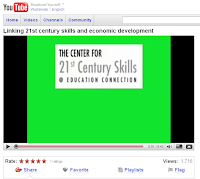 Schools have to teach 21 century skills, including critical thinking, communication, teamwork, creativity and technical skills. A lot of companies jump on these 21st century skills like the latest fad to be marketed. But come on, guys... if you claim to teach what 21st century skills are, you have to at least demonstrate them. I didn't even make it past the first minute of these guys' presentation (http://www.youtube.com/watch?v=W5OU8XoA3_0) which shows nothing but a boring picture for 51 whole seconds, voiced by the most boring human being in the universe. Very 19th century indeed.
 Schools have to teach 21 century skills, including critical thinking, communication, teamwork, creativity and technical skills. A lot of companies jump on these 21st century skills like the latest fad to be marketed. But come on, guys... if you claim to teach what 21st century skills are, you have to at least demonstrate them. I didn't even make it past the first minute of these guys' presentation (http://www.youtube.com/watch?v=W5OU8XoA3_0) which shows nothing but a boring picture for 51 whole seconds, voiced by the most boring human being in the universe. Very 19th century indeed.
Feminine

Yes, Shelearner is a she learner; I'm a woman and I love frills - now and then. And who could resist this netbook? Fashion in IT, does it mean that women are taken seriously as users or does it imply the exact opposite; are those guys at HP thinking; 'let's cover our netbooks in floral prints, so all those little women out there will be thrilled. They won't care about the technical aspects, as long as it looks pretty'. Or is there a woman at the HP-top who realizes that women do differ from men and rightly so - that we are not afraid to show our femininity and that that is exactly what makes our generation different from the one before us who claimed that women are the same as men and needed to be treated in the same way. When it comes to function and salary - yes, treat me in the same way. When it comes to social behaviour, communication skills and - yes - floral patterned netbooks - women are different and I for one don't mind showing it. So - where's my credit card?!
Tuesday, 27 January 2009
Netbooks

One child, one laptop; it's not just my motto, it just seems difficult to implement this in schools. And I'd love to be a kid again these days, especially when browsing through Amazon and running into all of those netbooks. I'm in love. The only reason I haven't yet ordered one yet is because I can't choose... I do hope sales will go up, because Asus has had to increase the price for their netbook after not making the required sales targets last year. How sad. Perhaps schools should start purchasing them. 2 euros per week per parent and each child can have their laptops paid for in less than 3 years... How difficult can that be in most West-European countries? Just look at this cutie, the Acer Aspire One A110 AB Sapphire Netbook. It has a cool blue design and is very light at less than 1 kg, it has a built in web-cam and also has the latest Intel mobile technology with the low voltage Intel Atom processor. Dixon sells it for 170 pounds sterling - with the current rates, that would be about the same in euros :-) The specs are as follows: Intel Atom N270 processor, 8.9″ CrystalBrite TFT Display, 512 MB memory, 8GB Flash Hard Drive, Linux Lite operating system, Built-in 0.3 Megapixel camera, Built-in card-reader and Up to 3 hours battery life.
Monday, 26 January 2009
No e-learning Crunch
The digital revolution has made us all into lifelong learners. Even when we don't want to, we have to keep learning, in order to keep track of our friends on Facebook, Hyves or Orkut, to work with the latest free version of Paint, to upload our pictures on Picasa or to write our latest idea in a blog. And because we've all become lifelong learners, school is only one place where we get our information from. It also seems that the current recession, which is affecting almost every country, does not affect the e-learning business. Creative solutions, cooperative learning, community tools - all useful to keep the costs of expensive traditional learning institutions down. What will teachers do if faced with this reality? Become Lifelong Learners too? Adopt new media and technology to support their teaching? Finally? That will be the day.
Monday, 19 January 2009
Geek Speak
A friend texted me that she'd jinged her homepage and twittered it, which had gained her 3 followers. Geek speak has become daily practice for large amounts of people. Not being Gen Y, I still remember the time when everyone was offline, not even having a mobile phone. The first mobiles were huge and very expensive too - you were an incredible show-off if you had one. And now the youngest generation, the Millenium kids, are carrying mobile phones as if it's the most normal thing in the world. They'd be lost without one. Does the mobile phone in his pocket give a 6-year old more independence or is it just the other way around? That's a thought for next time. For now I'd like to mention the website which will get everyone online; Gen X, Y or Millenium kid - even German teachers :-) www.teachertrainingvideos.com. Russel Stannard is the creator of this award winning website, of which the best part is again: it's for free! Enjoy Russel's videos, they're fun and easy to follow. It's like one-to-one tuition whenever it suits you. Did I mention before that I love shareware? Yes, I did.
Friday, 16 January 2009
First Post
My first post... well at least it sounds better than the last post. I will keep myself posted about the fascinating things I come across in the world of elearning. Having been a television producer, a creative manager and a primary school teacher, my skills and experience led me into the e-learning field. And I love it. Why don't all schools embrace open educational resources? It's free, userfriendly and useful. Let the kids teach their teacher, why not? Get the digital natives to inform the digital immigrants. I was born too long ago to be a digital native, although I feel like a spring chicken compared to the wise old men visiting elearning conferences. Generation Y is a hot topic, but where are they? I'm Generation X, interested in technology and the many useful applications for education. I just discovered Jing, something my 12-year old cousin has already been working with for ages now. It's like a present, all these open source applications, because I remember the time I could only get my hands on decent software by paying hundreds of pounds for it or by selling my body to the office graphic designer in exchange for an illegal copy of the so coveted software... And now; it's dive in and go, all for free and legal. I love It.
Subscribe to:
Posts (Atom)
21st Century Learning

- SheLearner
- Teacher, trainer, Head of IT, mum of three online teens, into social networks, open educational resources and visual learning. Head in the Global Cloud and feet in the Dutch clay.